

Volume 60
My eldest niece just turned eight, and at her birthday dinner, she shared something with me that left me speechless.
After she blew out her candle, I whispered, “What’d you wish for?” She usually tells me, “I can’t tell you, auntie, or it won’t come true.” But this time she said she was going to make an exception and with tears welling up in her eyes, she told me.
“I wished that your father was alive, so he could hang out and play with me. I wish for that on all my birthdays.”
She was only two years old when my father passed. I’m still in complete awe that an eight-year-old could be this aware of death and feel grief this deeply.
With tears in my own eyes, I told her how incredibly sweet that was, and I reminded her that he’s always with her. I told her it’s okay to miss somebody, it’s okay to cry when you miss somebody, and you don’t ever forget them. That’s how we keep them alive in our hearts. Then, as eight-year-olds do, she got distracted and quickly moved on to something else. Squirrel!
I haven’t stopped thinking of this moment.
She’s a lot like me, you see. When I was little, and for a long time in my life, I always used my birthday wishes to wish that everyone would be happy. I didn’t wish it for me, but always for everyone around me.
In education, we talk a lot about the next generation, and how it’s a privilege to do this work for them. But we don’t talk nearly as much about the people who came before us. These are the people who held us up, believed in us, and pushed education forward for the better, always standing up for what’s best for kids. My dad was one of those people for me, and so were a lot of my teachers. How do we honor them and keep moving their work forward?
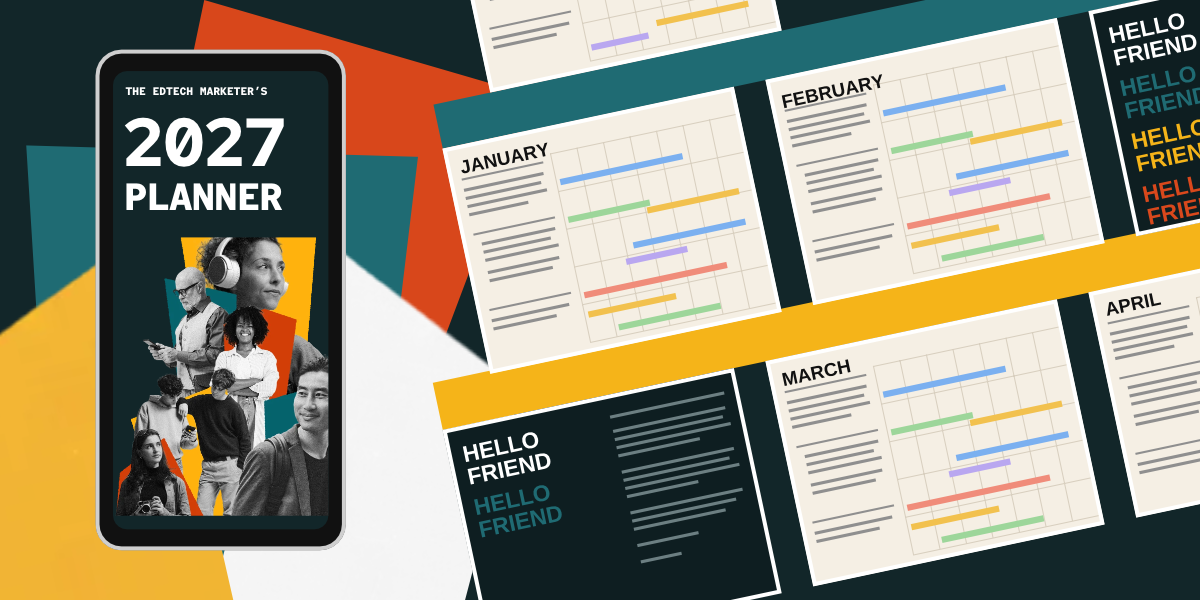
For me, part of the answer is in the work. I’m incredibly proud that LCG gets to help so many impactful education brands. We just released our seventh annual EdTech Marketer’s Planner for 2027, and I still can’t believe a small agency like ours gets to make something this robust and helpful year after year. Thousands of you have used it to make sure your content and social media are truly tied to what your audience values. And this year, we added something new...our Marketer’s Playbook!
But creating content is only half the battle. The other half is showing up and using what you create to form real, lasting relationships.
And maybe that’s how we honor the people we’ve lost, too. We carry their belief in us into everything we do, and every time we show up for someone else, every time our work makes a difference for kids, we keep them alive, not just on birthdays, but every day.
I can’t wait to see how you show up in 2027.
Elana
The 2027 EdTech Marketer’s Planner is Here! 🥳
Consider this your permission slip to start planning ahead for 2027. The free EdTech Marketer’s 2027 Planner gives you 12 months of conferences, awareness days, and holidays, plus a new monthly Marketer’s Playbook packed with the top education insights and buyer trends to plan around each month.

Resources Powered by LCG
AI Bans, Fall Deadlines, and What Will Get You A Response On LinkedIn (podcast)
K-12 EdTech Go-to-Market: Why Fifty States Are Really Fifty Different Countries (podcast)
[Popular] LinkedIn's Algorithm in 2026: What Works to Drive Reach and Engagement (blog)
[Trending] Why K–12 EdTech Sales Requires More Than a Great Demo (podcast), check out this clip of advice for early-stage EdTech teams picking their first markets.

A Proven Way To Generate School and District Leads
edWeb is one of the best ways LCG helps our clients generate consistent, qualified leads. Their edLeader Panels help demonstrate your brand’s expertise and impact, while building awareness and trust with your school and district buyers.
Learn more about edLeader Panels. Fill out this quick form and tell them LCG sent you! We’re also happy to introduce you to the edWeb team personally.
[Good human alert] LCG earns a commission from edWeb if you sign up, and we only recommend partners we trust with our own clients.

EdTech Good News
More students are staying enrolled past their first year, especially those who need it most. A new report from the National Student Clearinghouse Research Center finds first-to-second-year persistence rates rose across the board for the 2023 high school graduating class. Persistence among graduates of high schools in high-poverty areas climbed 1.7 percentage points to 76 percent, the largest gain of any group tracked in the report.

Marketing & Education Must Reads
Marketing
LinkedIn carousels pulled a 21.77% median engagement rate compared to 3.18% for text-only posts, and posts with a link preview got 44% fewer engagements, so it might be time to rethink where that link goes. (Buffer)
Trust is slipping, with 35% of social users saying they trust social media less than they did a year ago, and 28% want brands to stop posting AI content without a label. (Sprout Social)
One industrial manufacturer’s buyer-first content program brought in 600+ qualified leads and a 10.3% engagement rate in nine months, more than triple the 3.3% benchmark, by building content on customer research instead of guesses. (Content Marketing Institute)
After analyzing 800,000+ posts, Richard van der Blom found that 10 LinkedIn algorithm rules have flipped since 2024, and the biggest shocker is that only 31% of your connections now see your posts, down from 72%. (Richard van der Blom)
Only 17.2% of community pros can confidently quantify their community’s business value, according to CMX and Bevy’s 2026 Community Industry Report, and Richard Millington maps out a five-step ladder for putting customer expertise to work so yours doesn’t get lost. (CMX + FeverBee)
Bonus: Anthropic just launched Claude for Nonprofits, a free plugin built with about 30 nonprofits to help small teams with everything from fundraising research to board prep.
Platform Updates
Instagram: The Edits app now has an AI assistant that analyzes your Reels and suggests what to post next, from hooks and captions to trending audio. It’s free with a daily limit and rolling out in the U.S. They’re also testing videos up to 90 minutes long. Yes, you read that right.
LinkedIn: You can now pin comments, so your best brand reply or your audience’s favorite comment stays up top. Premium members are also getting SuperLikes.
Facebook: Some Pages are now capped at 2 posts or comments with outbound links per month unless they pay up through Meta One. It’s still rolling out, so yours may not be hit yet. Mari Smith shares 15 ways to keep driving traffic anyway. Our take: Just don’t use link posts.
Muse: Last month we gossiped about Meta’s gangbusters launch. Fast forward six weeks: more than 10 million people in the U.S. and Canada have set up personal AI agents, and roughly 25% use Muse on any given day. The catch? Analysts say it’s losing more money than any other product Meta has launched.
YouTube: Shorts recommendations now favor original content, so channels that repost other creators’ videos without significant changes will see less reach. Here are 5 things to focus on with the new algorithm. (You gotta watch these tips! So, so good!)
Education
Before you add another AI feature to your product roadmap, remember that only 1 of 10 EdTech products reviewed had third-party evidence its AI features improve outcomes, a gap district buyers are likely to start asking about. (EdSurge)
Nearly 3 in 5 educators used AI last school year, and half say it freed up time for students, but over 60% of teachers still haven’t gotten guidance on how to use it. (K-12 Dive)
Students with a trusted adult at school were 10% to 20% more likely to take advanced coursework, according to a study of 1.8 million student records, but not every student group has that kind of support at the same rate. (K-12 Dive)
A retired teacher on a principal hiring committee shares 10 potentially uncomfortable interview questions for school leaders, covering burnout, discipline, and “toxic positivity.” It’s a revealing look at what keeps educators up at night. (The 74)
Pilots can make or break a K-12 sale, and these 5 questions to ask before you launch one are a smart place to start, especially if you’re planning a pilot for spring. (RYE Consulting)
[Timely for conference season] Former superintendent Sean Bulson explains what he missed walking past the vendor hall for years, and what finally made him stop at a booth. (Sean Bulson)
As calls to limit screens in elementary schools grow, Lisa Nielsen argues that screen-time rules measure the device instead of the learning, and she makes the case for why individual devices are often what give young students access, from text-to-speech and translation to digital libraries. (Lisa Nielsen, The Innovative Educator)
Bonus: Helpful Education Reports & Resources
Bookmark this state-by-state tracker from EFTC Credit. Heading into 2027, 31 states have opted into the new federal Education Freedom Tax Credit and 16 are still undecided, so it’s an easy way to see where things stand before January 1.
K-12 Dive’s running tracker of school closures shows how many districts are closing schools because of declining enrollment, from Tulsa closing or consolidating 17 schools to Cleveland, where enrollment has fallen by half since 2004.
The Hechinger Report’s breakdown of the research on AI in education shows that while all 39 meta-analyses on the topic report positive results, an audit of 14 of them found serious flaws, and when the strongest studies were recalculated, the average effect was roughly zero.

Straight from The WirED Marketer
Keeping up with K-12 RFPs can be a full-time job, so we’ve compiled a few things we’ve seen over the last 90 days. Curious why we’re tracking RFPs? Put simply, they’re basically a crystal ball into what districts are about to spend money on.
Big RFP trends from the last 90 days:
AI-powered support, but with high levels of control
Connections to portraits of a graduate and durable skills
An uptick in asks for printed materials (not all that surprising, given all the talk about screen-time backlash)
Coherence across grades, especially in supplemental materials and assessment
And a bonus: as if there weren’t already enough acronyms, we’ve got another one: “A-ROI,” aka academic return on investment. It’s everywhere (along with outcomes-based contracts), and education companies should be especially aware of it in their marketing.
There's more where that came from. Sign up for The WirED Marketer, a 2x monthly newsletter by edmarketers for edmarketers.

In Good Company
This is our chance to brag on the clients and partners who make up our community. Here's what they've been up to lately:
CAST: Professional Learning and Implementation Specialist Kelli Suding was named to District Administration’s 2026-27 DA 100, which honors the most important voices in K-12 education.
Cerebrate: Alissa Kendall, principal of Traut Core Knowledge Elementary in Fort Collins, Colorado, shares in District Administration how her school is closing the skills gap behind student dysregulation, one year into the work.
NSSI: Fulton County Schools’ director of mathematics joined NSSI to explain why math fact automaticity belongs in every district’s math strategy, with takeaways from their October edLeader Panel.
Playworks: CEO Elizabeth Cushing joined Jethro Jones on Transformative Principal to talk about how play builds belonging and resilience, from inclusive recess to junior coaches who lead their peers.
TCI: TCI launched a new website that lets district committees review its new K-12 Social Studies programs anytime, without requesting access or booking a meeting.
Teach For America: At TFA’s 35th anniversary summit in Las Vegas, more than 150 couples who met through the organization renewed their vows in a group ceremony, officiated by Elvis, of course.
