Volume 50
As we get ready to close out the year, I’ve been thinking a lot about what 2025 has taught us and how we can use those lessons to move forward in 2026. Some people might say the pandemic was the year that changed everything in education, and in many ways it was. But 2025 was not a blip. It was a turning point. It was the year uncertainty stopped feeling temporary. It became part of how we operate.
In K-12 education, we saw ESSER funds go away. Federal funds froze, then unfroze, and left an even bigger trail of confusion behind. We saw the Department of Education get dismantled and the federal role in K-12 education become more and more limited. Amid all of this, districts paused and waited. In many cases, contracts were in limbo while leaders tried to understand what was real and what might change again. At the same time, AI moved from a buzzword to something that touches every corner of our work. New tools. New expectations. New risks.
The first six months of the year felt like everyone was frozen in that uncertainty. Panicked. Unsure. Wanting to move but not knowing how. And then slowly, almost quietly, something shifted. People moved anyway. They realized they could keep going even without all the answers. Uncertainty became part of the work, not a barrier to it.
That is the lesson we carry into 2026.
Districts are now asking more of the partners they choose. They want evidence. They want outcomes. Usage alone is not enough anymore. If your product is not tied directly to the goals and outcomes they purchased it for, renewals will be a challenge. Tech stacks are shrinking. Budgets are tighter. Simplicity, integration, and ease of use matter. Outcomes matter most of all.
This all doesn't mean we don't need plans. It means we make plans flexible enough to change them quickly (and you will be changing them a lot). Data, trends, and real conversations will continue to shape how you adjust and where you focus. It is a sign that you are paying attention. Data, trends, and real conversations will continue to shape how you adjust and where you focus.
As we step into January (which we lovingly call 'go time' since it's a critical part of the buying season), how you show up in the next quarter will shape more than this year’s numbers; it will influence renewals, multi-year partnerships, and the trust you build with educators and leaders as they decide which tools stay and which go. Show up consistently. Help your audience navigate the challenges that align with what your product or service actually solves. Support those who already use your tool so they can see the outcomes they hoped for when they said yes.
We cannot control what is coming. But we can prepare for it, and we can move through it with a little more confidence than we had last year.
Have a great break and talk to you in the new year,
Elana

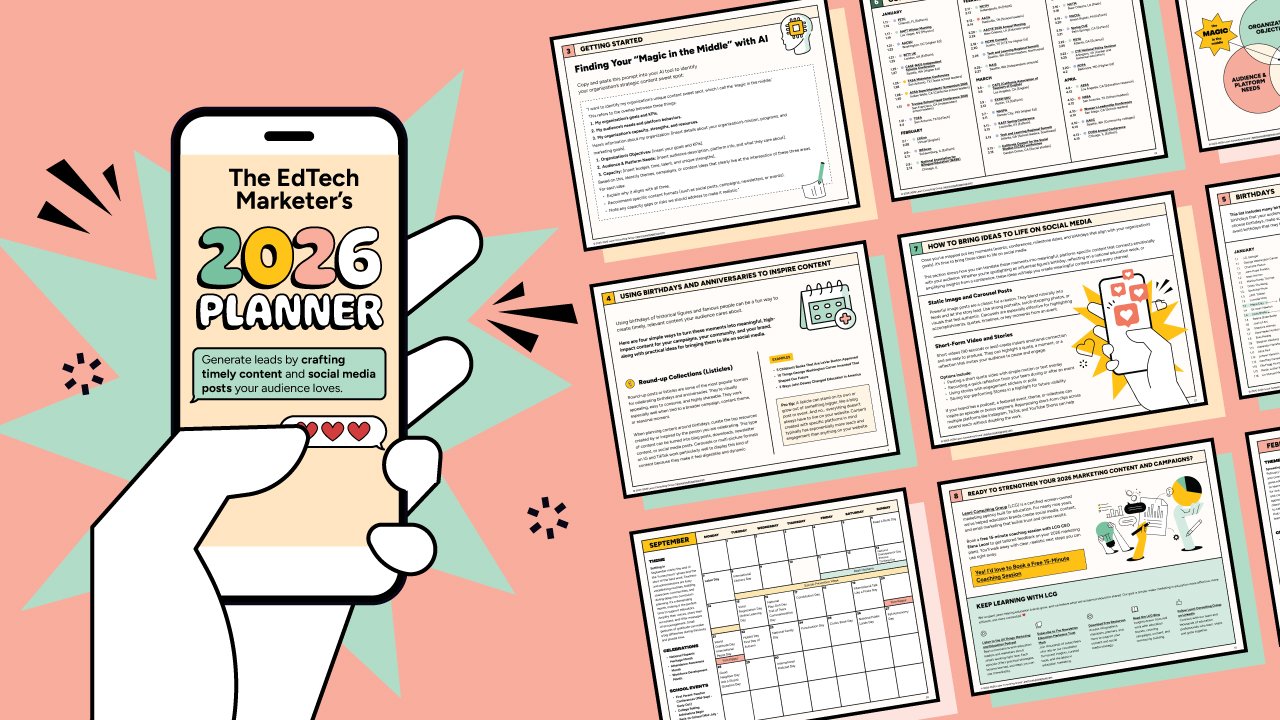
A Clear Starting Point for 2026 Planning
Planning 2026 does not require perfect clarity, but it does require a place to start. The 2026 EdTech Marketer’s Planner Spreadsheet ($49.99) offers an editable template to map key education moments, align social, email, and demand gen work.

New Resources Powered by LCG
How K–12 and Higher Ed Leaders Can Build a Meaningful Presence on LinkedIn (blog)
December Playbook: Support Teachers, Reach Leaders, and Get January Ready (podcast)
[Popular] 2026 EdTech Marketer’s Planner (free download)
[Trending] Landing Pages, Leads, and RFPs: A Practical Guide for EdTech Growth (podcast)

EdTech Good News
With student clubs and scholarships, Girls Who Code is on track to close the tech gender gap in new entry-level tech jobs by 2030.
Through its latest “Five by Five” initiative, Girls Who Code will expand programming for younger students, extend summer high school immersion programs to year-round, build regional chapters with alumni leaders, and support technical projects of college students. The aim is to reach 5 million students over the next five years.

Marketing
Richard van der Blom on LinkedIn Post Performance: A quick breakdown of five quiet mistakes that might be stopping your posts from getting seen (and how to fix them).
Social Media Examiner on Instagram Marketing: This post covers what’s actually working right now on Instagram, from content types to captions to timing. It’s a helpful gut check if reach is down.
Email Marketing Heroes on Common Mistakes: If your emails aren’t landing, this is a quick list of what might be going wrong and how to clean it up.
Social Media for B2B Growth on LinkedIn Pages: A clear breakdown of what’s changing with LinkedIn company pages and what B2B marketers should focus on in 2026.
FeverBee on Community Skills: Persuasion is one of the most useful skills for community pros, and this post breaks down how to get better at it without being pushy.
Education
Edutopia on Education Research: A roundup of recent studies on what’s actually working in classrooms, from feedback strategies to self-paced learning.
Australia on Social Media Bans: Australia’s push to limit teen access to social media sounds simple, but it’s complicated. This piece looks at the risks, especially for youth who rely on these platforms for support and connection. (Bonus: a Wall Street Journal video on what the students have to say).
Greater Good on Education and Indoctrination: This piece digs into the line between teaching and telling, and why helping students think critically matters more than pushing any one view.
Education Week on the 2025 Word of the Year: This year’s pick is “rebuild.” It reflects how schools are responding to budget cuts, staffing shortages, and growing pressure to rethink the system.
K–12 Dive on ICE and School Climate: A new UCLA report shows principals are seeing real impacts from immigration enforcement in their communities, including drops in attendance and rising fear among students and families.
EdTech Magazine on 2026 District Priorities: Heading into 2026, district leaders are focused on cybersecurity, staffing, and balancing innovation with limited budgets.
Hechinger Report on 2025 Ed Research: From tutoring to AI, this roundup highlights the top 10 education studies of the year and what they reveal about what’s working—and what’s not—in schools.
Bonus: Education Week on Engaging K–12 Leaders: If you're trying to reach school and district leaders, this guide breaks down what gets their attention, what turns them off, and how to build real trust over time.
Dates to put on your radar:
If you're heading to FETC, apply by December 22 to pitch your EdTech startup live and compete for funding and exposure.
Heading to NAESP next summer? Apply by December 31 to present at the national conference and share ideas that spark connection, confidence, and joy for school leaders.
The National Conference on Education, presented by AASA (#NCE2026) is headed to Nashville, TN Feb 12-24, 2026. t’s not too early to start preparing, whether that means researching speakers, setting up meetings, or getting clear on what success looks like for your booth before the rush begins.

A new analysis from Burbio outlines the topics that school boards spent the most time addressing last quarter, compared to Q3 of 2024: Federal (57.4%)
IEP (25.5%)
Newcomers (19.4%)
Artificial intelligence (18.3%)
MTSS (17.9%)
Student safety (15.6%)
College and career readiness (12%)
Cybersecurity (12%)
Teacher shortages (9.1%)
Science of reading (7.3%)
Enrollment declines (6.4%)
Bonus bonus:
Before you close the laptop for the year, we wanted to share a few videos that made us smile. Nothing strategic, nothing to analyze, just a reminder that laughter and lightness still matter, especially after a year like this one.
Sometimes that pause is exactly what helps us come back clearer in January.