

EdTech brands love the word "community." They use it to describe email lists, Facebook groups, user forums, ambassador programs, and everything in between. The label gets applied early and often, almost always before the people inside the space have said it themselves.
The thing is, a community is not something a brand can declare. A community only truly exists when the members say it does, when they feel genuinely connected to each other and not just to a platform or a product.
My team and I have spent years partnering with EdTech brands on community strategy, and I recently joined my friend Monica Burns on her Easy EdTech Podcast to dig into this topic in depth. In particular, I talk about the most common mistake I see: confusing an audience with a community. Knowing the difference is not just semantics. It changes what you build, how you sustain it, and whether it survives the inevitable moments when leadership asks what it is all worth.
The Difference Between an Audience and a Community
Most EdTech brands are not actually building communities. They are building audiences, and there is nothing inherently wrong with that. The problem comes when the two get treated as the same thing. We’ve written an in-depth article about the difference between an audience, community, and a network. Here’s a preview:
An audience is a group of people you talk to. They may follow you, open your emails, attend your events, and engage with your content. But they probably aren’t aware of each other, don’t directly collaborate with one another, and generally don’t engage with other members. A network is a step further. Members join with a goal to find what they came for, and leave. Interactions tend to be transactional. They get what they need, and generally have a “take” mentality and leave.
A community is something different entirely. The true test of a community is if members actually care about one another, and that caring is not something a brand can install. You can create a space, seed it with content, moderate it carefully, and watch the member count climb. But none of that makes it a community. It becomes one when the members decide it is.
That shift is harder to manufacture than most brands expect, and more consequential than they realize. When members start asking how each other are doing, noticing when a familiar voice goes quiet, showing up not just for the content but for each other, that is when something real has started. Until then, what you have is a useful foundation. Calling it a community does not make it one.
Educator Community Building Starts with Moving at the Speed of Trust
The most common reason a community stalls is not that the platform is wrong or the content is not great. It’s that the brand is moving faster than the members are ready to go.
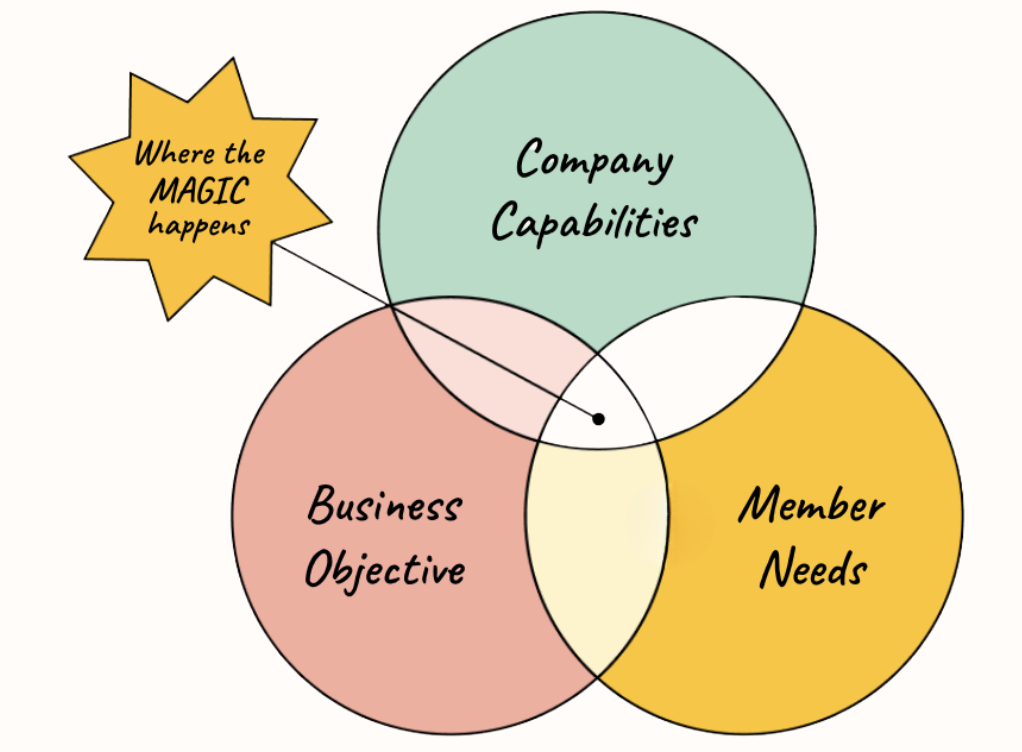
We think of this concept as what we like to call moving at the speed of trust. Trust is critical for a community. If you don't have trust, you may not have a space that allows people to feel safe enough to be vulnerable, and that vulnerability is exactly what turns a group of people into something that matters. When we partner with an EdTech company to build a community, we don’t create a community based on a founder’s vision for what the space should become. We co-build it with the community members, and together, we wayfind to what we call the magic in the middle. That beautiful middle that aligns with member needs, business needs, and business capabilities.
Spoiler Alert: The pace at which you co-build this community always takes longer than you think, and it cannot be forced. We move at the pace required, and it’s different for each and every community we help build.
Members need to feel safe enough to say they are struggling, to share something that did not go as planned, to take the risk of being seen by their peers. This doesn’t happen because a brand creates a welcoming graphic or sends a warm onboarding email. It happens through consistent, patient behavior over time.
The brands that skip this step tend to build spaces that feel active on the surface but hollow underneath. We sometimes like to call these “mirage communities.” Members show up, consume, and leave. They do not connect. What gets built is a highly managed audience, not a community.
Co-Creation Is the Foundation of a Lasting EdTech Community
One of the clearest signs that a community is not going to last is when all the initial activity comes from the brand. This isn’t a community, it’s an RSS feed.
Communities need to be created with your members. You co-create from day one. When we start a community from the ground up, one of the first things we do is identify a small group of core members who will co-own the direction, content, and purpose with us. Sometimes we call it a launch crew or a power user group. In practice, that means:
Co-owning conversations alongside the brand, not just participating in them
Helping identify and welcome new members
Weighing in on what the community does next, not just reacting to brand decisions
I cannot underscore enough the importance of elevating member voices and empowering them to grow the community the way they want it (as long as it aligns with your business objectives). It all sounds simple, but it reality, it’s incredibly complex work, and most brands resist it in practice. They want to control the direction, the tone, the agenda. And in doing so, they create something members feel invited into rather than something they feel they belong to.
Why Most Educator Community Members Lurk (And What That Means for Engagement)
The metrics most EdTech brands use to measure community health is visible activity: posts, comments, reactions, threads, etc. By that measure, most communities look like they are underperforming. The reality is that 90 percent of community members, in any community, will lurk.
Lurkers are digesting the information but they're showing up. They just might not be contributing in a way that exposes themselves. That’s not disengagement. It’s just how most people participate, especially in a space where they are still figuring out whether it is safe to show up more visibly. The first time someone comments in a group, it’s genuinely uncomfortable. And especially in education, it’s a big risk. In some educator communities, screenshots of posts may be brought to schools, people may be judged, and comments may be harsh.
The question is not how to convert the 90 percent into active posters but more so whether their needs are actually being met. Are they getting something useful from being there? Do they feel seen even when they are quiet? A community that works for its lurkers and contributors has a foundation built to last.
Why EdTech Communities Fail: The Leadership Buy-In Problem
Most communities don’t fail because the members stop caring. They fail because someone inside the brand stops seeing the value (or lacks the patience to allow it to grow so it can provide business and member value).
The number one reason communities fail is a lack of buy-in from senior leadership. I have watched this play out more times than I can count. A community is thriving, members are engaged, and real connections are forming. Then a leadership change or a budget review surfaces the same question: how does this translate to what we actually care about as a company?
If you cannot answer that with specificity, the community is at risk. Not because it is not working, but because the people who fund it cannot see how it connects to their business goals. That is a measurement and communication problem, not a community problem. But it ends communities all the same and with it, creates a growing distrust and negative reputation of the education brand.
This is also the main reason that our EdTech marketing agency is highly selective about which education brands we partner with. If there’s not compelling evidence that they will be in it for the long haul, they don’t have what it takes to foster a healthy community, and they are just wasting educators’ time. And there’s nothing that annoys us more than disrespecting educators’ time.
Building community requires sweat equity: time, attention, and consistency over the years. It is not a quick one-and-done campaign. Understanding where your community is in its lifecycle helps you identify the most appropriate actions to grow it effectively. The brands that treated community as a transactional channel rather than a commitment are entirely missing the point and wasting everyone’s time.
What a Real Educator Community Makes Possible
The EdTech brands that build real communities are not just investing in engagement metrics. They are investing in the professional lives of the educators who use their products. Depending on your community’s purpose, it can foster product innovation, surface best practices, help others become more active users, resolve product issues or requests, and so much more.
Regardless of the primary focus, communities can fundamentally change and even save lives. In turn, it will also influence every part of your business. But it doesn’t happen overnight. It not only requires constant dedication, but also strategic communication within your organization to ensure internal understanding of the benefits it provides (and ideally to align them with your strategic and operational plans).
Teaching is one of the most isolating professions, and community is the antidote to that isolation. When a brand builds something real in this space, it is not a marketing channel. It is a place where educators grow.
That is a high bar. It requires patience, co-creation, trust-building, and the organizational will to sustain it when the ROI is not immediately legible. But the brands that clear that bar earn something that cannot be bought: the loyalty of educators who associate their own growth with the space you gave them to find each other.
Build something your members would call a community. That is the whole standard.